A biotech website for investors has one job: confirm what your deck claims, quickly enough that the investor keeps reading. They look for a clear thesis, pipeline and stage, the team, dated news, data, funding history and a named contact, and they notice when any of it disagrees with the deck.
Key takeaway: Investors use your website to check whether the story in your deck holds up. A clear thesis, a dated pipeline, a visible team and verifiable evidence make that check easy.
Get it right and the first meeting starts with your science instead of basic questions. Get it wrong and you may never hear why the reply did not come.
What should a biotech website for investors show?
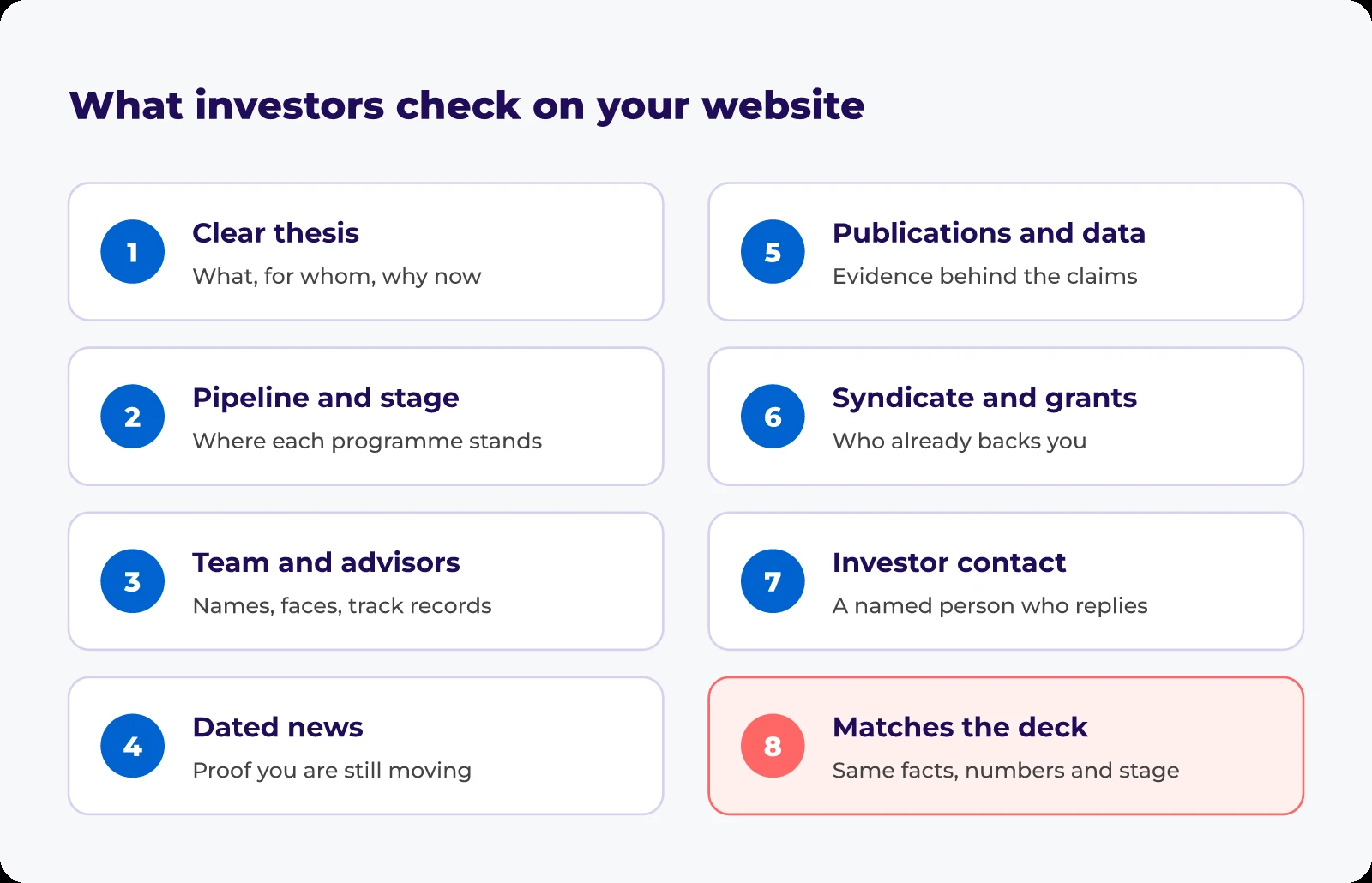
Investors look for evidence that the deck is true and current. I treat it as a quick check of the deck, and the site has to pass it in minutes.
- One clear thesis: what you do, for whom and why now, on the homepage in plain words.
- Pipeline and stage: each programme or product, its indication or use, and where it stands today.
- Team and advisors: names, photos and relevant track records, including the board and scientific advisors.
- Recent, dated news: milestones, data readouts, partnerships and key hires, each with a visible date.
- Publications and data: papers, posters and preprints that support the core claims, with links.
- Syndicate and grants: who already backs you, from investors to public funders.
- An investor contact: a named person or address, so nobody has to use the general form.
- Consistency with the deck: the same numbers, names and stage everywhere.
Why your website matters before the first meeting
I would assume every investor meets your website before they meet you. A warm intro or a cold email leads to a quick look at the site, and the deck is then read against it.
In diligence, the site becomes a reference point that can be checked. Clinical studies sit in a public registry run by the US National Library of Medicine, and EU-funded projects and their participants are listed on CORDIS. If your site and those records disagree, someone will notice.
This applies well beyond biotechnology drug developers. A diagnostics company, a CRO or a CDMO raising capital faces the same check, with validation data and customers in place of a clinical pipeline.
Strategy note: If a claim matters enough to put in the deck, it should be findable on the site, with a date and a source.
Where biotech websites lose investor trust
I think trust goes through small gaps far more often than through weak science. Each gap on its own looks minor. Together they suggest a team that is not on top of its own story.
| What the investor sees | What they may conclude |
|---|---|
| The latest news predates the last round | Momentum has stalled, or the round was hard |
| A pipeline chart without stage labels or dates | The timeline is softer than the deck suggests |
| A team page with no bios or no advisors | Experience is hard to verify |
| A homepage written only for specialists | The founders may struggle to explain the business to the next investor |
| The deck says clinical, the site says preclinical | Which is right, and what else is out of date? |
I think the thesis is the hardest of these to fix, because it is a messaging question before it is a design question. That is covered in how to simplify biotech messaging for investors. The homepage also has to pass the 5-second test.
What should be in place before you update the site?
Most of the work is agreeing the facts, long before anyone builds a page. Check that you have these ready.
- An agreed one-line thesis that the CEO, the deck and the homepage all use.
- A current pipeline or product table with stage, and the date it was last checked.
- Approved bios and photos for leadership, board and scientific advisors.
- A list of public proof: publications, registry entries, grants and awards, with links.
- Permission to name names: investors, partners and funders who have agreed to be listed.
- One owner for news and investor content, who reviews it before each round of outreach.
- A named investor contact who replies promptly.
Turning that into a site that works for investors and scientists at once is where most teams want a second pair of eyes. That is what our life science web design work is for.
A good investor website makes your deck easier to believe
Your deck makes the case, and your website shows the case holds up. Build both from the same facts and update them together, before outreach starts rather than after the first awkward question.
If the deck is the weaker of the two, start there. Our biotech pitch deck support and the guide to building a biotech pitch deck investors can follow are good places to begin.
Preparing for a raise? Book a short call to talk through your website and deck before investors see them.
Frequently Asked Questions
For a private company, a biotech website for investors needs only a light one. There is no share price or filings to publish, but a short page with the thesis, funding history, key milestones and a named contact saves investors time. Keep confidential material, such as the full deck or data room, available on request.
In most cases, no. A public deck dates quickly, can be shared without context and removes a reason to get in touch. Publish the facts the deck relies on, and offer the deck itself on request through the investor contact.
Check it before every round of outreach and after every milestone. Anything with a date, from news to pipeline stage, should match what you are telling investors that week. One named owner makes this realistic for a small team.
Show what can be verified instead. Posters, preprints, patents, grant awards and named academic collaborations all help. Be precise about your stage, because an honest preclinical story reads better than vague language that hints at more.