
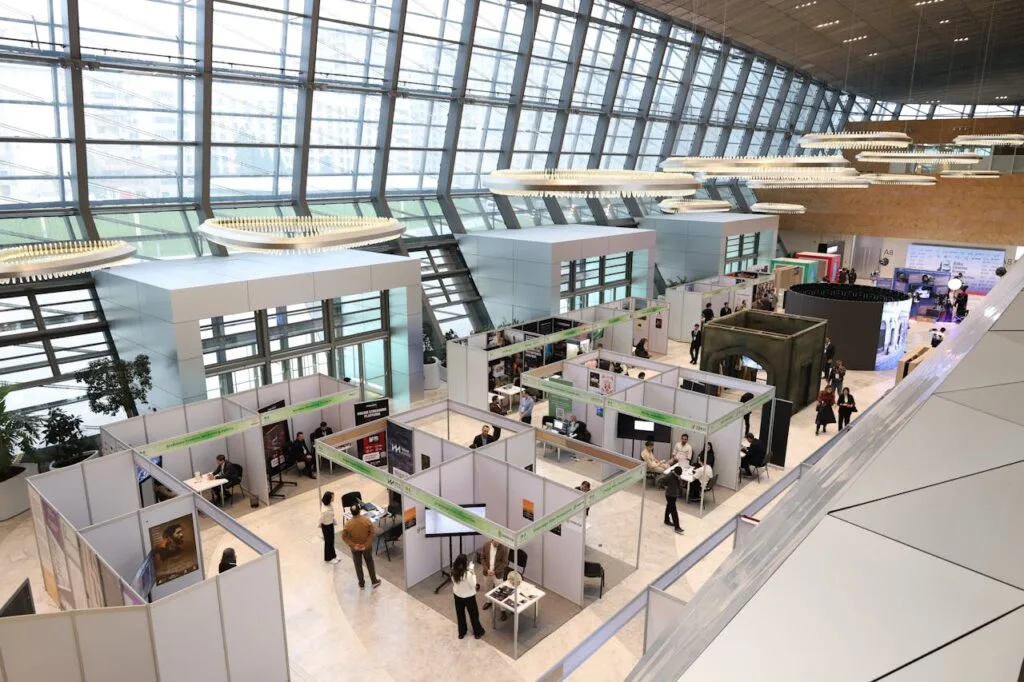

Life science conference booth design works best when it helps the right scientific, technical, or commercial audience quickly recognize who you are, understand what you offer, and decide whether a conversation is worth starting. A strong booth is not only a visual asset. It is a live marketing environment where positioning, messaging, design, sales materials, and follow-up all have to work together.
Many biotech, CRO, CDMO, diagnostics, and scientific product companies invest heavily in booth graphics but underinvest in the communication system around the booth. The result is often a professional-looking space that still feels hard to interpret from the aisle. Visitors may see a logo, a technical claim, and a few abstract visuals, but they may not immediately understand the company’s category, relevance, or reason to engage.
Key takeaway: A life science booth should work as a recognition system first and an explanation system second. Visitors need to notice, categorize, and remember the company before they can evaluate the technical message.
1. Make the Booth Recognizable Before It Is Readable
Large consumer brands understand recognition with unusual discipline. Coca-Cola, for example, does not depend on long explanations at the point of attention. Its red color, script logo, bottle shape, display style, and repeated brand cues help people recognize it almost instantly across stores, events, packaging, vending machines, and advertising.
Life science companies should not copy consumer branding, but they can learn from the principle. At a conference, recognition comes before comprehension. A visitor walking past a booth needs to recognize the company’s category, field, and relevance before they slow down enough to read technical copy.
For a biotech, CRO, CDMO, diagnostics company, or scientific instrument company, recognition can come from repeated elements such as color, typography, product imagery, scientific diagrams, icon style, booth architecture, and message hierarchy. These elements should create a coherent identity across the booth, brochure, website, sales deck, and follow-up material.
2. Use One Primary Message Instead of Several Competing Claims
Many scientific booths try to communicate everything at once. A company may want to talk about its technology, platform, pipeline, service model, quality systems, speed, expertise, data, and partnerships in the same visual field. The booth then becomes harder to process, even when every individual claim is valid.
The primary booth message should give the right visitor a fast reason to stop. That message may focus on a workflow challenge, a development bottleneck, a service category, a product advantage, or a specific scientific application. Supporting details can appear in secondary panels, printed materials, demo screens, or conversations.
Strategy note: The booth headline should not carry the full burden of persuasion. Its role is to create enough relevance for a qualified person to start a conversation.
3. Design for the Walking Viewer
Conference attendees rarely read booth copy in the way they read a website page or brochure. They scan from a distance, often while walking, talking, checking the event app, or looking for a specific stand. That means the booth has to communicate in layers.
The first layer should answer the category question. The second should show relevance. The third should provide evidence. When all three layers have similar visual weight, the viewer has to work too hard.
- Category: what kind of company this is
- Relevance: which problem, workflow, or audience it serves
- Evidence: what supports the claim
- Action: what the visitor should do next
4. Translate Technical Complexity Into Workflow Relevance
Scientific audiences do not need oversimplified messaging, but they do need orientation. A technically strong message can still fail if it does not explain where the product, platform, service, or technology fits into the buyer’s work.
A CRO booth may need to connect services to clinical development stages. A CDMO booth may need to show process development, scale-up, quality, or manufacturing relevance. A diagnostics booth may need to clarify sample type, clinical setting, laboratory workflow, or adoption pathway. A scientific instrument booth may need to show how the product changes throughput, sensitivity, reproducibility, usability, or data interpretation.
This is where biotech positioning and messaging becomes practical. The booth message should help people understand the technology in the context of a real scientific or commercial decision.
5. Make the Audience Obvious
A life science booth should make it clear who the company is speaking to. A founder, procurement lead, principal investigator, clinical operations team, process development scientist, laboratory director, investor, or pharma partnering executive will each look for different signals.
When the audience is vague, the booth often becomes generic. The company may describe what it does but fail to show who should care. Audience-specific messaging helps visitors self-identify quickly and gives booth staff a stronger opening for discussion.
6. Use Proof Points That Can Be Absorbed Quickly
Scientific credibility matters, but booth proof has to be selective. Long technical claims, dense data tables, and broad statements about expertise can be difficult to absorb in an exhibition setting. The strongest proof points are specific enough to create confidence and concise enough to scan.
- validated methods or assays
- sample types supported
- development stages served
- manufacturing scale or capacity
- regulatory or quality experience
- published data or technical references
- partnerships or application areas
The goal is not to put the full evidence package on the wall. The goal is to give qualified visitors enough confidence to ask a more detailed question.
Practical framework: Build booth proof around the fastest confidence signals: what you can do, where it fits, who it helps, and what evidence supports it.
7. Align Booth Design With Sales Conversations
A booth should support the conversations your team needs to have. If the visual story says one thing and the sales team opens with another, the experience feels fragmented. This often happens when design, commercial strategy, and technical input are handled separately.
Before approving booth artwork, teams should ask how each visual element will help a real discussion. The headline should help staff open the conversation. The diagram should help explain the science. The proof points should support credibility. The handout should continue the same story after the visitor leaves.
This is especially important for companies developing life science marketing materials for high-value, long-cycle sales conversations. The booth is often the first touchpoint in a more complex buying or partnering process.
8. Prepare Supporting Materials That Match the Booth Intent
Brochures, one-pagers, QR landing pages, demo screens, posters, and slide loops should extend the booth message rather than introduce a separate narrative. When each asset has a different emphasis, the visitor has to reconstruct the company’s story across multiple pieces of material.
Supporting assets should be built around the same positioning system as the booth. They can go deeper than the booth graphics, but they should preserve the same audience logic, message hierarchy, terminology, proof points, and visual identity.
9. Plan the Post-Event Journey Before the Event Starts
A conference booth is part of a longer commercial sequence. The work should not end when the event closes. Strong booth planning connects the live interaction to lead capture, follow-up emails, landing pages, sales decks, technical calls, and partner discussions.
This is where booth strategy connects with broader biotech marketing strategy. A well-designed booth can generate attention, but follow-up determines whether that attention becomes a useful commercial conversation. The digital follow-up journey should feel like a continuation of the booth experience rather than a separate campaign.
Need stronger conference materials? Biond Marketing helps life science companies translate technical positioning into booth messaging, brochures, sales collateral, and follow-up assets that support serious scientific and commercial conversations.
Conference Booths Need Recognition, Relevance, and Continuity
The strongest life science conference booths are not judged only by how polished they look. They help the right audience recognize the company quickly, understand its relevance, trust its scientific credibility, and continue the conversation after the event.
Consumer brands show how powerful recognition can be when visual elements are used consistently. Life science companies can apply the same underlying principle with more technical discipline. A booth should make the company easier to notice, easier to understand, and easier to remember, without reducing the scientific substance that gives the offer its value.