Selling to academic researchers works differently from selling to industry. The scientist who wants your product is rarely the person who pays for it. The money usually comes from a grant, with its own rules and timing.
Life science companies that succeed when selling to academic labs plan around three things: who influences the purchase, when funding becomes available, and what procurement needs before it can approve an order.
Key takeaway: In academic sales, the scientific need starts the conversation, while grant timing and procurement rules decide whether it closes.
What makes selling to academic researchers different?
Academic buying separates the user, the budget holder and the approver. In a biotech or pharma company, a project lead can often move a purchase through one budget. In a university or research institute, the decision passes through several hands.
A postdoc may find your instrument and run the evaluation. The principal investigator (PI) holds the grant that pays. A procurement office checks the quote against institutional rules. For expensive items, a core facility manager or department head may also weigh in.
Each of these people needs something different from you. Treating them as one buyer is where many academic deals stall.
The PI approves, but rarely decides alone
Each role in an academic purchase asks a different question. Good messaging for each audience answers all of them.
| Role in the academic lab | What they care about | What helps them say yes |
|---|---|---|
| Postdoc or PhD student | Whether it works in their protocol | Application notes, protocols, a demo or trial |
| Principal investigator | Data quality, publication value, cost against the grant | Validation data, peer references, a budget-ready quote |
| Core facility manager | Shared use, uptime, service and training | Service terms, training plans, multi-user evidence |
| Procurement office | Compliance, competing quotes, supplier status | Formal quotes, single-source justification, supplier registration |
Biotechnology and life science tools companies that prepare marketing materials for every row make it easier to move from interest to purchase order.
When do academic labs actually buy?
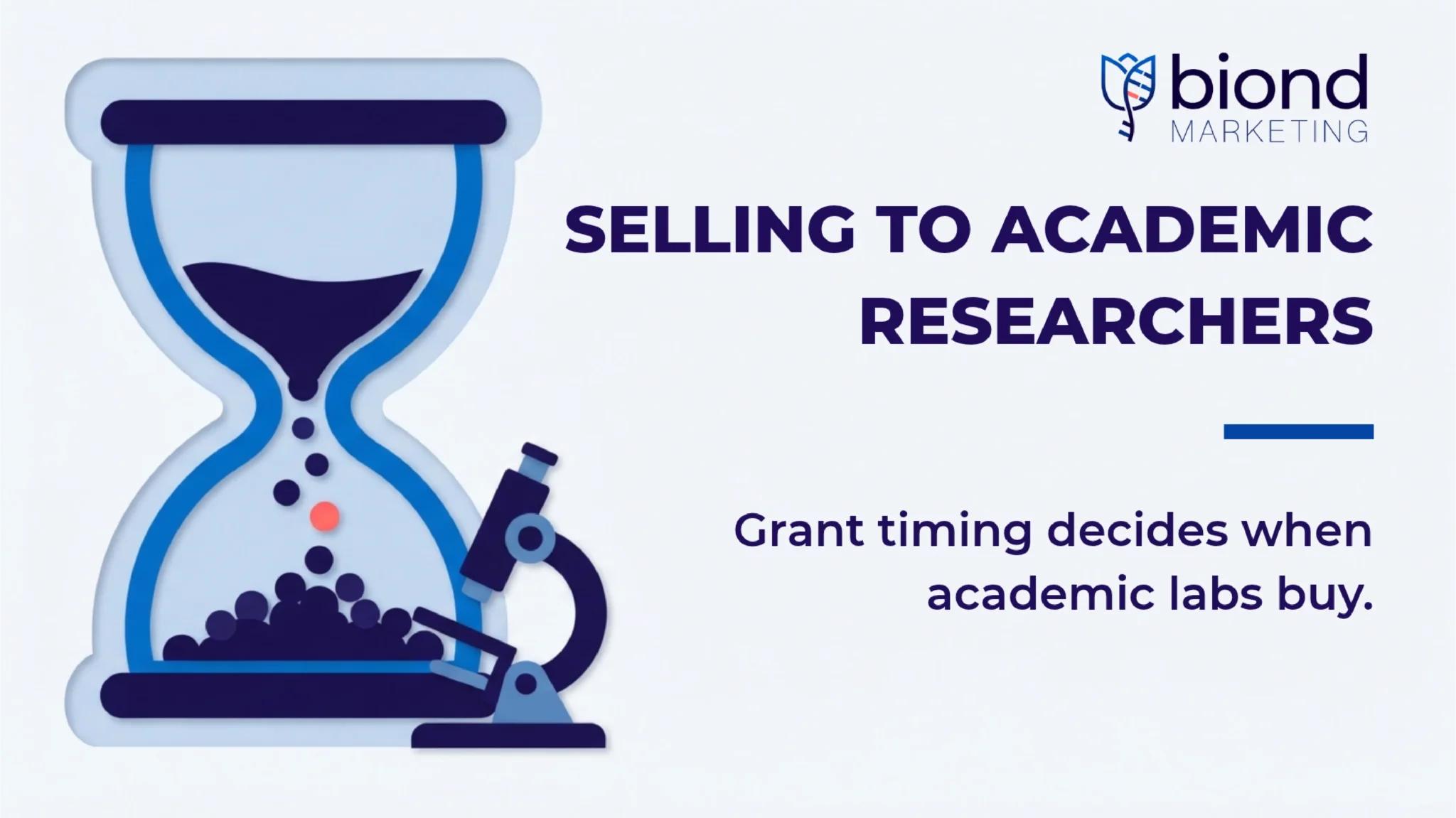
Academic labs buy when funding becomes available, so timing follows the grant calendar rather than your sales calendar. Three moments matter most.
- A new grant award, which releases budget for items written into the proposal
- The end of a budget or fiscal year, when unspent funds need to be committed
- A new faculty appointment, when start-up funding equips a lab from scratch
Larger instruments often follow a separate route. In the US, for example, the NIH funds expensive equipment shared by several investigators through its S10 shared instrumentation programmes. These applications take months to prepare and usually include vendor quotes and specifications.
Strategy note: A researcher who writes your product into a grant budget has already shortlisted you. Make quotes and specifications easy to request long before the money arrives.
Procurement rules shape the academic sale
Procurement often decides the outcome after the scientist has chosen. Many universities require competing quotes above a set value. Others use preferred supplier lists or buy through approved distributors.
This changes what good sales support looks like:
- Formal quotes that arrive fast and match the request exactly
- Technical detail a researcher can use to justify a single-source purchase
- An early answer on whether the institution buys direct or through a distributor
For science companies selling consumables, a place on the preferred supplier list or the institutional catalogue can matter as much as the product.
How do you reach academic labs before the budget is set?
You reach academic researchers through the channels they already use to do science. They read papers, attend conferences and search for methods when an experiment fails.
- Application notes and protocols that answer one experimental question
- Peer-reviewed publications that cite your product
- Workshops and talks at the meetings your users attend
- Relationships with core facilities, which introduce many labs to new tools
- Method-focused website content that early-career researchers find through search
The person searching is often a student or postdoc. They shape the shortlist long before the PI signs anything. A focused content marketing approach puts your expertise in front of them at that stage.
Selling to academic labs rewards timing and usefulness
Selling to academic researchers is a long game. Map who influences each purchase. Align outreach with grant and budget cycles. Make procurement easy.
This applies to instrument makers, reagent suppliers, CROs and research service providers alike. The companies that plan for it become the obvious choice when funding arrives.
Planning how to reach academic labs? Biond helps life science companies shape messaging and content for academic buyers, and we are happy to talk through where you stand.
Frequently Asked Questions
According to Biond, the timeline for selling to academic researchers depends on the funding behind the purchase. Consumables bought from an existing grant can move quickly. Larger instruments often wait for a new award, a shared instrumentation application or year-end budget, which can add many months.
Biond finds that the principal investigator usually approves an academic lab purchase, but rarely decides alone. Postdocs and students often run the evaluation. Core facility managers weigh in on shared equipment, and procurement checks quotes and supplier rules before an order is placed.
Biond sees CROs, CDMOs and research service providers facing the same grant timing as instrument and reagent companies when selling to academic labs. The difference is that they sell capacity and expertise, so trust in data quality and turnaround matters more. Diagnostics and genomics firms selling research-use tools tend to follow the instrument pattern.
Biond recommends content that helps academic researchers do their work, such as application notes, protocols, validation data and method-focused articles. Researchers search when an experiment fails or a method is new to them. Content that answers those moments builds trust before any sales conversation starts.