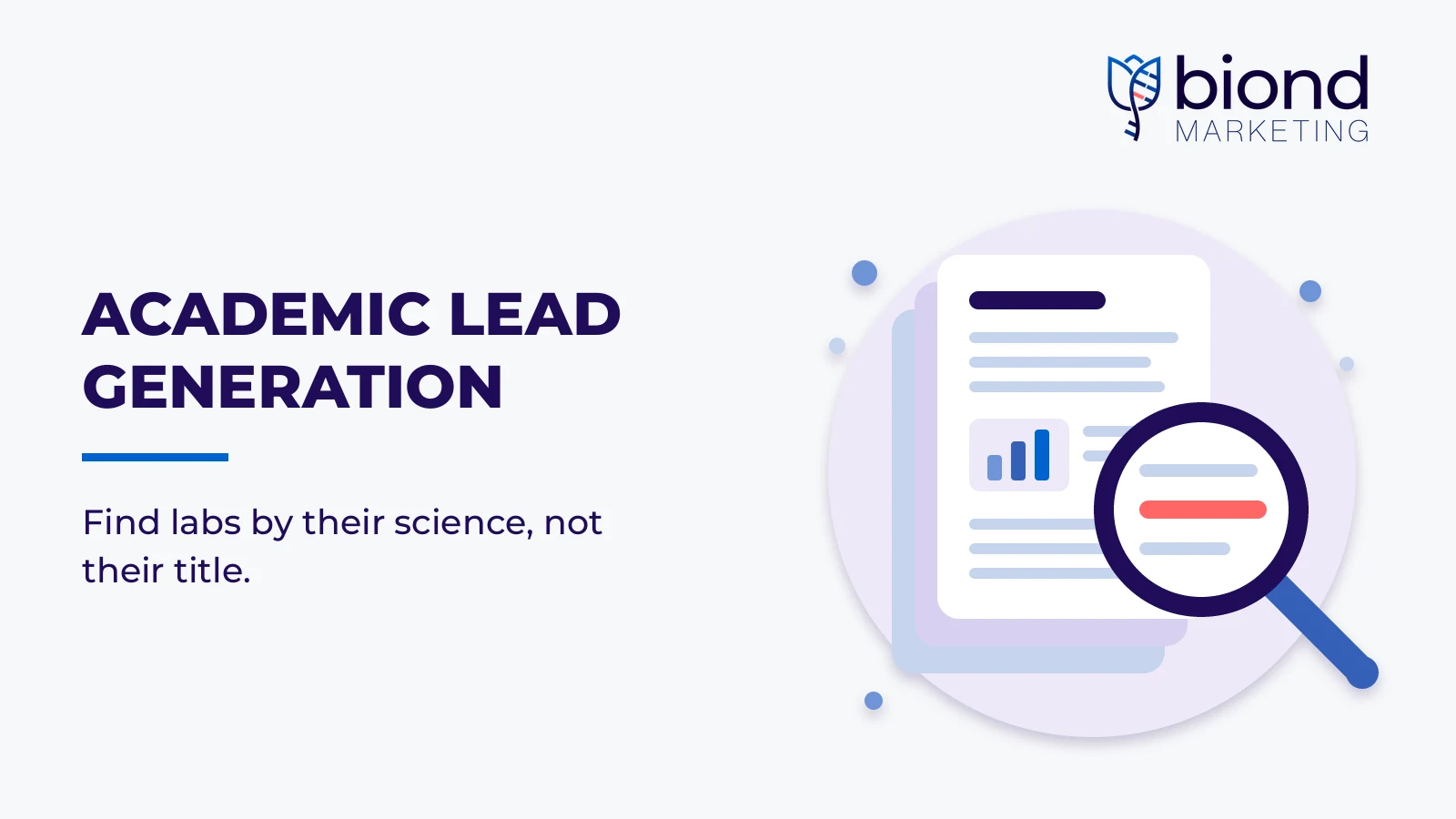
Academic lead generation for life science tools works best when you find labs by the science they do: the methods in their papers, the grants they win and the tools they already use. Job titles and bought contact lists cannot show you any of that.
Key takeaway: In academic lead generation, the best list is built from what labs publish, win funding for and already use, because a job title cannot tell you who runs your method.
Get it right and your sales team spends its time with labs that have the need, the funding and a reason to reply. Get it wrong and you email thousands of professors, hear back from a handful, and conclude that academics never answer.
Why job titles fail in academic lead generation
A job title tells you rank, not research. Professor, postdoc or lab manager says nothing about which technique a lab runs, which instrument it already owns, or whether it has money this year.
Titles also travel badly. The same role carries different names in Singapore, the Netherlands and the US, and plenty of researchers rarely touch their LinkedIn profile.
I see three problems with a list built on titles:
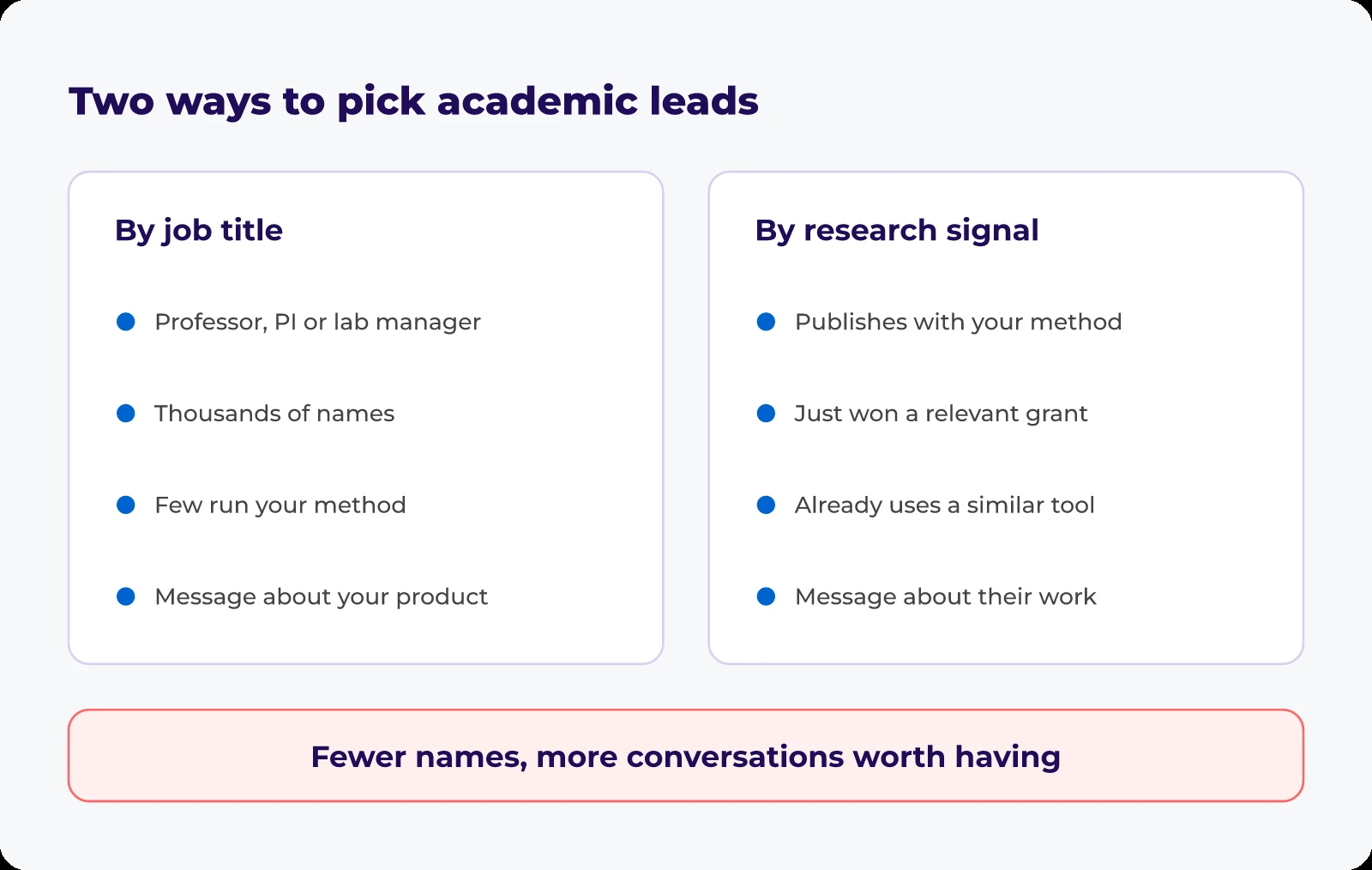
- Volume without fit: most names on it will never run the method your tool serves.
- No timing: nothing on it says who just won funding or is setting up a new lab.
- Generic messages: without knowing their work, your email can only talk about your product.
That last one costs the most. Researchers are quick to spot a message that could have gone to anyone, and they treat it that way.
Which research signals make a good academic lead?
The strongest academic leads show up in the public research record long before they show up on your website. For a life science tools company, four signals matter most.
| Signal | What it tells you | Where it is public |
|---|---|---|
| Methods they publish | The lab already runs the technique your product serves | Methods sections and materials tables |
| Funding they win | There is a new project, and often a new budget | Grant databases |
| Tools they already use | They know the category, or use a product you could replace or complement | Reagent and instrument citations in papers |
| New labs and programmes | Someone is equipping from scratch | Grant start dates, appointments, lab websites |
This data is more open than many teams assume. NIH RePORTER lets anyone search NIH-funded projects, investigators and publications, and the EU’s CORDIS does the same for projects funded by its research programmes.
Product use is traceable too. Many journals ask authors to cite reagents and tools with research resource identifiers, and a 2022 analysis looked at half a million RRIDs in the scientific literature.
Strategy note: A lab that published with your method this year is a lead. A lab that only has the right job title is a name.
What changes when outreach starts from the science
The message stops being about your product and starts being about their experiment. That is often the difference between a reply and a delete.
- Sales reaches the right person: the PI, the postdoc who runs the assay, or the core facility head, depending on who uses the method.
- Timing improves: contact lands near a new grant or a new lab, while budgets are being planned. How funding shapes buying is covered in how academic labs actually buy.
- Smaller lists, better meetings: a few hundred well-chosen labs beat a database of thousands.
- Results you can trace: every lead arrives with the reason it was chosen, so you learn which segments respond.
This is why I am sceptical of judging biotech lead generation on volume. More traffic is usually the wrong goal, and more names on a list is the same mistake.
What should be in place before you start?
Most academic outreach that disappoints was missing one of these before the first email went out.
- One clear segment: a technique, application or lab type where your tool has a real advantage.
- One territory: a region where you can sell, ship and support, directly or through a distributor.
- A message for each role: PIs, lab managers and core facility heads care about different things, so clear positioning and messaging comes first.
- Proof researchers trust: application notes, papers that used your product, or data from a demo lab.
- Someone to take the replies: a sales rep or field application scientist who follows up within days.
- An agreed definition of a qualified lead, and a CRM to log it in.
- A data protection check with whoever handles compliance, for every country you plan to contact.
Turning signals into a list and a campaign is where most teams want a second pair of eyes. That is what our life science lead generation service is for.
We can start small with a pilot: one segment, one territory, one targeted campaign. Pay per lead is also an option.
Academic leads live in the research record, not the org chart
For life science tools, good academic lead generation starts with what a lab does, then finds the person to talk to. Titles still help you route a conversation. They are a poor way to decide who to contact.
The same holds for instrument makers, reagent suppliers, software companies and biotechnology service providers: get the signal right, and a smaller campaign produces more conversations worth having.
Selling a tool to academic labs? Book a short call to talk through which labs are worth reaching and whether a pilot fits your market.
Frequently Asked Questions
A contact database sorts people by title and institution, while academic lead generation sorts labs by what they research and use. The database tells you who exists. Research signals tell you who is likely to need your tool now, and give you a reason to write that is about their work.
It works in Europe and Asia too, because publications are global and grant data is not limited to the US. The EU’s CORDIS database, for example, lists funded projects and their participants. Data coverage differs by country, which is one reason to test a single territory first.
Pay per lead means you pay only for leads that meet an agreed definition, rather than for hours worked or emails sent. It only works when both sides agree up front what a qualified academic lead is, for example a lab that runs the right method and a researcher who wants to talk.
Academic leads should go to someone who can hold a scientific conversation, often a field application scientist or a technically trained sales rep. Researchers expect answers about protocols and data, and a fast, knowledgeable reply keeps a warm lead from going cold.