Biotech SEO decides what an investor, a pharma partner or a candidate finds in the minutes after your company name comes up. Done well, your search results and website tell the same story you would tell in the room, and the right people get in touch.
Key takeaway: Biotech SEO controls the first impression of your company for people who are already interested, so your search results and website should tell the same story you would tell in the room.
Done badly, they find an outdated page, a company with a similar name, or nothing at all. Here is what the work is worth, where it goes wrong and what to prepare first.
What is biotech SEO actually worth?
It shapes the first impression for people who are already interested. Anyone weighing up your company is likely to search for it first, and what they see decides the next step.
- Investor diligence: your science, team and momentum are easy to find without a data room.
- Partner discovery: business development scouts searching a target, modality or platform can find you on the shortlist.
- Hiring: candidates judge your credibility from the same pages.
- Scientific standing: researchers who find your work can reach your company in one click.
Who searches for a biotech company, and what do they check?
Four audiences use search differently, and one weak page can fail all of them. This holds for biotechnology developers as much as for life science tools and diagnostics firms.
| Audience | Looks for | Your page must settle |
|---|---|---|
| Investors | Science, team, funding history, momentum | Is this credible, and is it moving? |
| Pharma partners | Platform, pipeline stage, modality | Could this fit our portfolio? |
| Candidates | Mission, science, open roles, leadership | Is this worth joining? |
| Press and researchers | Spokespeople, publications, plain explanations | Can I cite this accurately? |
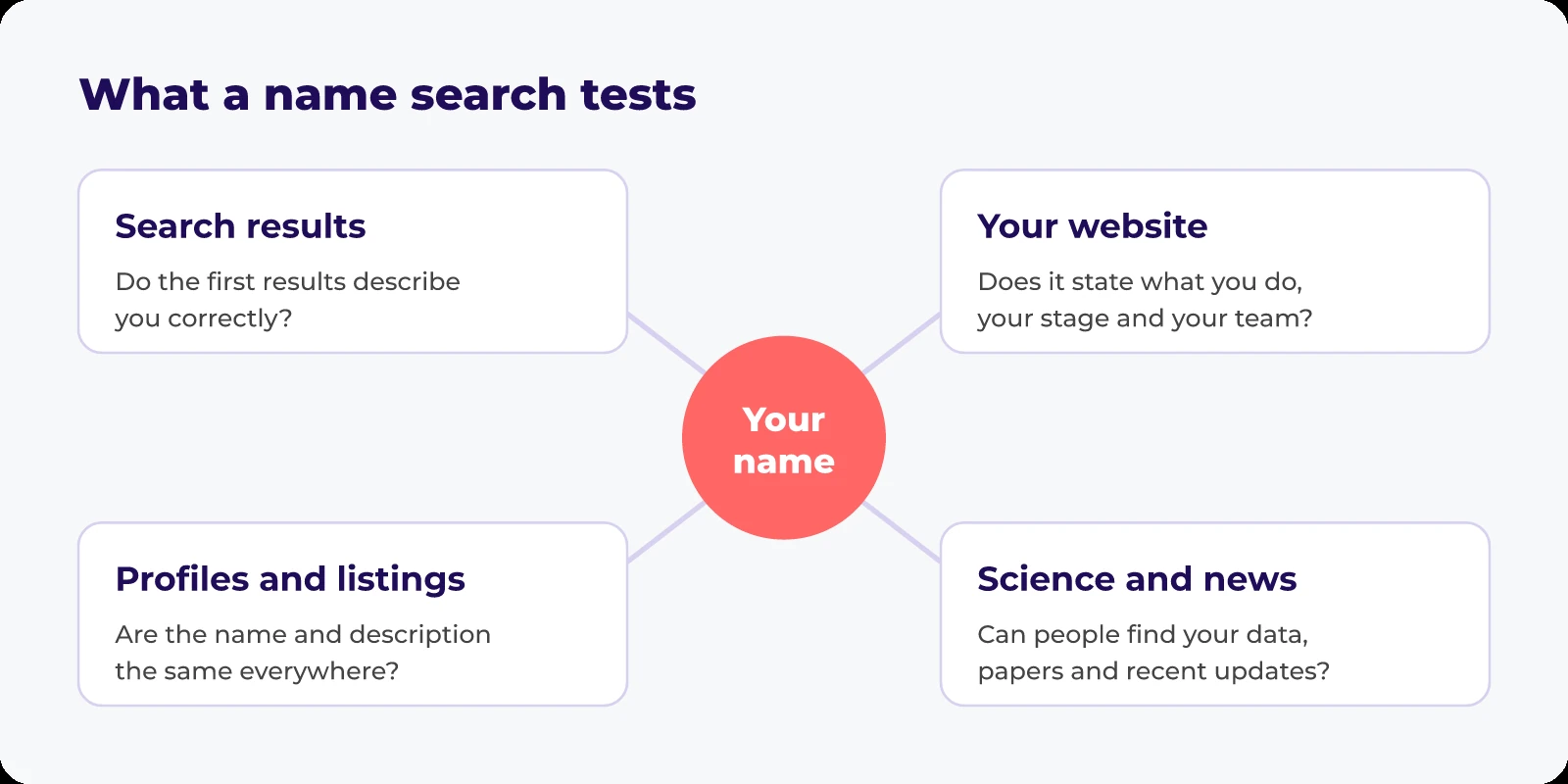
Most biotech SEO problems show up in a name search
Most problems are findable in an afternoon. Search for your own company the way an investor would and check these first.
- Name collisions: your company name matches another brand, a place or a common word, so the results show someone else.
- Facts buried in decks and PDFs: pipeline and platform detail that few visitors will ever open.
- Faceless teams: no bios, so Google’s who, how and why check has nothing to work with.
- Stale news: a news page that stopped two years ago suggests a company that has stopped moving.
- Aiming at the word “biotech”: it attracts students and job seekers, not the people you want.
A first-time visitor also needs the basics to be obvious within seconds. See why biotech websites fail the 5-second test.
What should you prepare before you start?
A project moves faster when the facts are agreed before anyone writes a page.
- One approved description of what the company does, in a sentence and in a paragraph.
- Cleared wording for science, pipeline status and any claims, with a named approver.
- Team bios and photos for leadership, scientific advisers and board.
- A list of where the company is described today: LinkedIn, investor databases, conference listings and publications.
- Consistent company details: the same name, address and identifiers, which helps Google tell your organisation apart from others.
- Access: Search Console, analytics and the person who can edit the site.
Deciding what to say, and in what order, is where most founders want a second opinion. It is the kind of question our team helps with through positioning and messaging.
Biotech SEO makes your story findable and consistent
Treat your search results as the front door to fundraising and partnering. If the story is clear on the first page of results, every deck and email you send lands on firmer ground.
That includes the deck itself, which is covered in how to build a biotech pitch deck investors can follow.
Wondering what investors find when they search for you? Book a short call and we will talk through how your company shows up and what matters most to fix.
Frequently Asked Questions
Biotech SEO is the work of making a biotech company findable and credible in search for investors, partners, candidates and scientific buyers. It covers the website, the way the company is described elsewhere online, and the content that answers what each audience asks.
Often more than a later-stage company, because there is less else to go on. Investors and partners judge an early company mainly on its website, team and science pages. A clear, consistent presence does not replace data, but it stops a weak first impression from hiding it.
Google states there are no additional requirements to appear in AI Overviews or AI Mode beyond standard SEO fundamentals. Pages need to be indexed, crawlable and readable as text, and structured data should match what is visible. Clear, consistent company information is the practical groundwork.
One named person, usually in marketing or business development, with a scientist who approves content and someone who can edit the website. Without an owner, company descriptions drift and profiles go stale.