Life science SEO puts your product in front of scientists who already have the problem you solve, months before they ask anyone for a quote. Done well, enquiries arrive from people who have read your method, understand the fit and want a technical conversation.
Key takeaway: Life science SEO pays when your site answers the questions a scientist asks long before requesting a quote, so the first call starts with a buyer who already trusts your method.
Done badly, you rank for terms that no buyer uses, or you rank and nobody trusts what they find. Here is what the work is worth, where it goes wrong and what to have ready first.
What does life science SEO actually deliver?
Qualified enquiries from people who are already searching for a solution. A scientist who types a specific method, assay or workflow problem into a search engine is in the middle of a project.
- Shorter first calls: the buyer arrives having read how your method works.
- An evidence trail: lab managers and procurement can check your claims without waiting for you.
- Reach beyond your network: scientists who have never heard of you but have the problem you solve.
- Assets that keep working: a page that answers a hard question is still bringing people in long after it was published.
Scientific searches involve several people with different questions
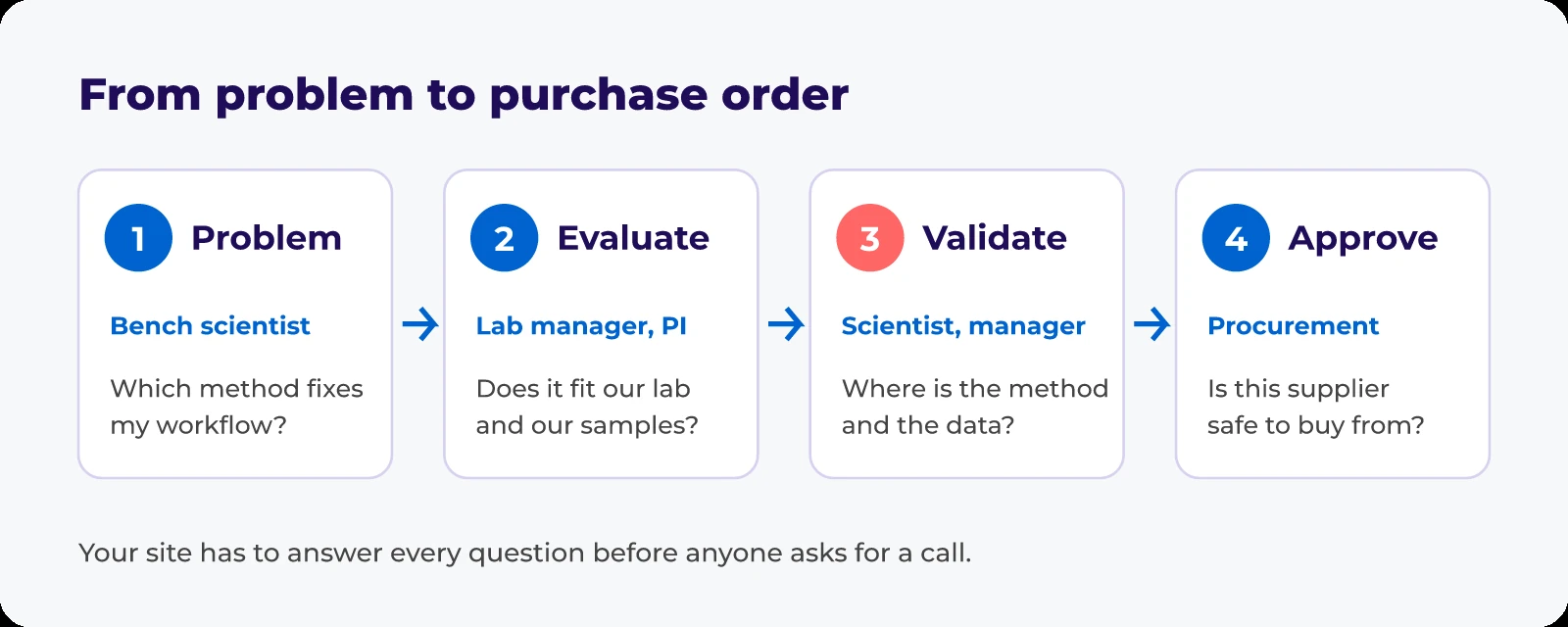
One purchase involves several people, and each searches for something different. The bench scientist looks for a method, the lab manager for fit and support, and procurement for proof that you are a safe supplier.
| Role | Typically searching for | Your site must settle |
|---|---|---|
| Bench scientist | A method, an application or a fix for a workflow problem | Will this work for my samples and my question? |
| Lab manager or PI | How suppliers compare on fit, validation and support | Will it run in our lab without surprises? |
| Procurement | Company background, compliance and references | Is this supplier safe to buy from? |
Volumes are small and intent is high. A term that few people search can still be the one your next customer types. Academic buyers add grant timing, which is covered in how academic labs actually buy.
Where does life science SEO go wrong?
Most failures come from aiming at the wrong person or the wrong proof. These are the patterns I would check first.
- Chasing volume: the biggest terms attract students and job seekers, not buyers.
- Writing for one role: a page that serves only the bench scientist leaves procurement guessing.
- Specs without substance: product pages that list features but never show the method or the data behind them.
- Anonymous content: Google’s guidance calls trust the most important part of E-E-A-T, and a named scientist behind a page supports it.
- Hunting for AI tricks: Google says there are no extra requirements for AI Overviews beyond standard SEO fundamentals.
What should you have ready before you start?
A project moves faster when these are in place before anyone writes a page.
- A named audience: who buys, who influences and who signs off.
- Application detail you may publish: methods, sample types and performance data that are cleared for release.
- A scientist who will put their name on content, and an approval route for claims.
- Access: Search Console, analytics and a person who can edit the site.
- The questions buyers ask most, collected from sales and support in their own words.
This is the point where most teams want a second pair of eyes, because deciding which searches are worth owning is where results are won or lost. It is the kind of question our team works on in life science digital marketing.
Life science SEO works when it follows the buying journey
Build for the scientist with the problem, the manager who checks the fit and the buyer who signs. Tools are the easy part. The judgement on which questions to answer, in what order and with what evidence separates a site that collects traffic from one that collects enquiries.
For the wider picture of how this fits with the rest of your marketing, read how scientific buyers find you. It applies equally to biotechnology, tools, CRO and diagnostics companies.
Planning life science SEO? Tell us what you sell and who buys it, and we will talk through where search fits your sales cycle.
Frequently Asked Questions
It builds over months, not weeks. Search engines need to find, index and trust new pages, and scientific buying cycles are long. Early signals such as the right queries appearing in Search Console usually come before enquiries do. Anyone promising a ranking date is guessing.
In the details, yes. Buyers are technical, several people take part in one purchase, search volumes are small, and claims must be accurate and approved. The core principle is the same as anywhere: helpful, trustworthy content written for the people who will use it.
Google states that there are no additional requirements to appear in AI Overviews or AI Mode beyond standard SEO fundamentals. Pages need to be indexed, crawlable and written as readable text. Other assistants work differently, so it is worth testing what they say about your company.
Yes for the basics, as long as one person owns it and a scientist reviews the content. Strategic choices, such as which questions to answer first and which audiences to serve, usually benefit from outside experience.