

CRO positioning is often where the real problem starts.
Many CROs are capable. Many have strong teams, solid processes, and a real track record. But when life science companies land on their website, the difference is not always obvious.
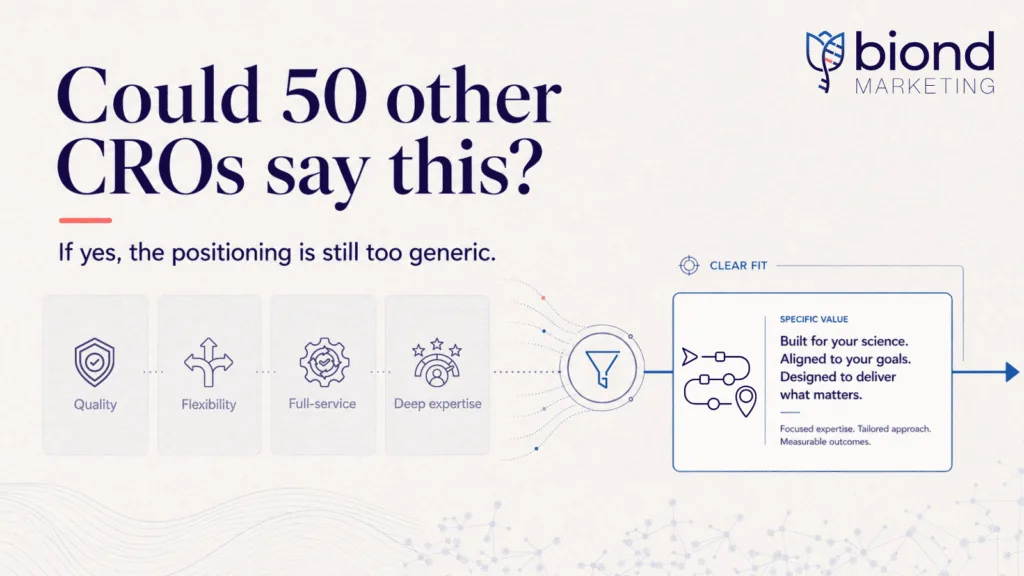
The language sounds familiar. Full-service support. Deep expertise. Flexible delivery. High quality standards.
None of that is necessarily wrong.
It is just rarely enough to help a buyer decide.
Life science companies do not choose a CRO based on capability lists alone. They are trying to judge fit, relevance, communication, and delivery risk. They want to know whether this partner understands the work, the pressure, and the realities around it.
That is why clearer positioning and messaging matters.
Why CRO differentiation is harder than it looks
Most CROs operate in a market full of other credible providers.
That creates a strange problem. The closer competitors become in capability, the more important clarity becomes in positioning.
From the CRO side, the difference may feel obvious. One team may be stronger in early clinical programmes. Another may be better at cross-functional coordination. Another may work especially well with growing biotech, medtech, or broader life science companies.
But from the buyer side, those differences often disappear.
If the website mainly lists services, therapeutic areas, and technical capabilities, buyers can see what exists. What they cannot always see is where the CRO is strongest, who it is best for, and why that matters.
That is where CRO positioning often misses the mark.
What life science companies actually look for in a CRO
Most buyers are not just asking, “Can you do the work?”
They are asking a more practical set of questions.
Do you understand this kind of programme?
Have you handled this level of complexity before?
Will communication stay clear when timelines shift or issues appear?
Will working with you make progress easier or harder?
That usually comes down to four things.
Relevant expertise
Buyers want to see expertise that fits their actual situation.
Not just a broad list of therapeutic areas. Not just a long service menu.
They want signs that you understand the type of study, the internal constraints, and the stage they are operating at.
Relevant expertise builds confidence faster than generic breadth.
Confidence in execution
This is one of the biggest trust signals a CRO can offer.
Life science companies want to know whether you can deliver with structure, oversight, responsiveness, and realistic expectations. Scientific depth matters, but so does operational discipline.
Execution is not a background detail.
It is part of the value proposition.
Clear communication
Communication is often treated as secondary in CRO messaging. It should not be.
Sponsors want transparency. They want issues raised early. They want visibility, not polished vagueness.
Especially for smaller teams, clear communication reduces friction and speeds up decision-making. That makes it a commercial advantage, not just a service detail.
Fit with company stage
A startup, a scale-up, and a more established life science company do not buy CRO support in the same way.
Some need guidance as much as execution. Some need specialist support that plugs into an internal system. Some need flexibility without losing control.
Strong CRO positioning shows awareness of that difference.
Where most CRO positioning goes wrong
Most CRO positioning does not fail because it is inaccurate.
It fails because it is too broad.
When a CRO tries to sound relevant to everyone, it often becomes harder for the right client to recognise a clear fit. The message becomes safe, but not persuasive.
Another common issue is that the language is too internal. The CRO explains its services, infrastructure, and capabilities from its own point of view, but does not make the buyer’s decision easier.
Then there is the generic wording problem.
Quality. Flexibility. Client focus. Tailored solutions.
These phrases are common because they feel safe. But safe language rarely differentiates. If every competitor says the same thing, those words do not help a buyer shortlist you.
This is where a sharper marketing strategy helps. Promotion is not the first fix. Clarity is.
What stronger CRO positioning looks like
Stronger CRO positioning is usually more specific, not more dramatic.
It should make three things clearer. Who the CRO is best for. What kind of work it handles especially well. Why that combination is valuable to the buyer.
That does not mean making the business look smaller than it is.
It means making the value easier to understand.
A lot of CRO messaging stays too broad because it relies on language that sounds credible, but could apply to almost anyone.
For example:
“We provide high-quality, flexible CRO support across a broad range of therapeutic areas.”
The problem is not that this is wrong.
The problem is that it is hard to act on.
It does not tell the buyer who this CRO is really for, what it is especially good at, or why it is a better fit than other credible options.
The test is simple:
Could 50 other CROs say this?
If yes, it is still too generic.
A more useful formula is:
We help [specific type of client] with [specific type of work] at [specific stage / geography / context] by [specific strength].
For example:
We help emerging biotech companies run early clinical studies in APAC by combining local trial execution with clearer sponsor-side oversight.
That is stronger because it gives the buyer something concrete. A clearer client type. A clearer kind of work. A clearer reason to believe this CRO may be the right fit.
That is what stronger positioning does.
It makes your value easier to recognise.
That is also where better scientific storytelling comes in. The goal is not to simplify the science. It is to explain why your way of working matters.
Conclusion
Life science companies are not only choosing a CRO. They are choosing a partner they believe can handle complexity without creating more of it.
That is why CRO positioning matters.
If your website only describes capabilities, buyers may understand what you do without understanding why you are the right fit. Clearer positioning helps the right prospects recognise themselves faster, trust you sooner, and move toward a conversation.
The goal is not to sound bigger.
It is to sound clearer.
FAQ
What is CRO positioning?
CRO positioning is how a CRO defines and presents its value in the market. It explains who the company is best for, what kind of work it is strongest in, and why buyers should choose it over similar providers.
Why does CRO positioning matter?
It matters because life science companies are comparing more than services. They are judging fit, execution confidence, communication, and risk. Clear positioning helps them see relevance faster.
How is CRO positioning different from CRO messaging?
Positioning is the strategic foundation. Messaging is how that position gets expressed in website copy, proposals, and sales materials. Weak messaging is often a sign of unclear positioning underneath.
Why do so many CROs sound the same?
Because many rely on broad claims like quality, flexibility, and full-service support. Those phrases are common across the sector, so they do little to differentiate one CRO from another.