

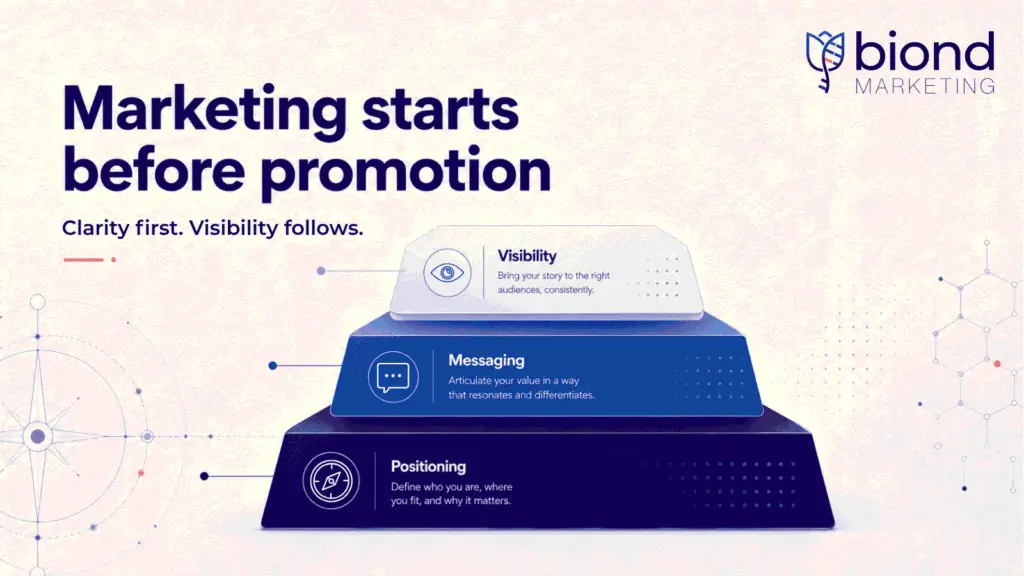

A biotech marketing strategy is the work of making a startup’s science, value proposition, differentiation, and commercial relevance clear enough for investors, partners, customers, and technical stakeholders to understand and act on. For a biotech startup, marketing begins with positioning, scientific messaging, investor communication, website clarity, and market visibility before it becomes promotion, campaigns, or advertising.
This distinction matters because many early-stage biotech companies are not held back by a lack of activity. They are held back by unclear communication. The science may be strong, the platform may be promising, and the team may be credible, but external audiences still struggle to understand what the company does, why it matters, and where it fits commercially.
Key takeaway: Biotech marketing is not simply the promotion of a scientific company. It is the strategic communication work that makes complex science understandable, credible, differentiated, and commercially relevant.
Biotech Marketing Starts Before Promotion
Many biotech founders first think about marketing when they need a website, a pitch deck, a conference brochure, a LinkedIn post, or a campaign. Those assets matter, but they perform poorly when the underlying message is still uncertain.
Before promotion begins, a biotech startup needs to answer a more fundamental commercial question: can the right audiences quickly understand what the company is building, why the problem matters, and why this approach deserves attention now?
When that answer is unclear, more visibility often creates more confusion. A polished website may still leave visitors unsure what the platform does. A technically detailed investor deck may still fail to communicate the opportunity. A conference campaign may generate conversations that the company is not yet ready to convert.
For that reason, early biotech marketing strategy should focus on the foundations that make later growth more coherent.
- Who are the priority audiences at this stage?
- Which problem does the company solve most clearly?
- How should the technology be positioned in the market?
- What proof points are most relevant to investors, partners, or customers?
- How should the scientific story be translated without weakening accuracy?
- Does the same core message hold up across the website, investor deck, sales materials, and leadership conversations?
Why Biotech Startups Often Define Marketing Too Narrowly
Biotech companies are usually built around science first. That is appropriate. The company needs credible research, a defensible technology, a realistic development path, and a strong understanding of the biology, chemistry, engineering, diagnostics workflow, or therapeutic context behind the innovation.
The challenge is that scientific confidence inside the company does not automatically translate into market understanding outside the company.
Founders may assume the importance of the work is evident. Scientists may explain the mechanism in depth, while commercial stakeholders are still trying to understand the use case. Business development teams may know the highest-value application, while the website still describes the technology too broadly. Investors may see promise, but not yet see the shape of the opportunity.
Strategy note: In biotech, marketing becomes valuable when it helps the company move from internal scientific understanding to external market comprehension. That requires more than simplified language. It requires disciplined positioning.
Biotech Marketing Is Partly Scientific Translation
Biotech marketing often involves translation, but the goal is not to dilute the science. The goal is to make the science usable for different decision-making contexts.
A venture investor, pharma partner, clinical collaborator, procurement lead, principal investigator, diagnostic lab director, and scientific reviewer may all need to understand the same company. They will not all evaluate it through the same lens.
Investors are looking for the opportunity, defensibility, market logic, milestones, and reasons the company is worth backing. Strategic partners are looking for fit, complementarity, and development relevance. Customers or end users are looking for practical value, workflow fit, reliability, and risk reduction. Technical stakeholders are looking for credible evidence that the scientific claims can withstand scrutiny.
Strong biotech positioning and messaging helps a company speak to these audiences without fragmenting into several disconnected stories. The core narrative remains consistent, while the emphasis changes depending on the audience and context.
That balance is difficult. Overly technical messaging can make the value hard to grasp. Overly simplified messaging can create credibility risk. The right level of communication preserves scientific substance while helping the reader understand why the company matters.
What Biotech Marketing Actually Includes
Biotech marketing is often reduced to visible outputs: a website, a conference banner, a slide deck, a few social posts, or paid campaigns. Those outputs are part of the discipline, but they are downstream of a wider strategic system.
For a startup, biotech marketing can include several connected areas.
Positioning
Positioning defines how the company should be understood in the market. It clarifies category, audience, application, differentiation, and the reason the company deserves attention. For biotech startups, positioning is especially important because the science may be applicable across several possible markets, but the company still needs a clear commercial entry point.
Weak positioning often sounds broad, impressive, and difficult to place. Strong positioning helps a reader understand what the company is, who it serves, what problem it addresses, and why its approach is meaningfully different.
Scientific Messaging
Scientific messaging turns complex technical information into language that different audiences can understand. This includes company messaging, platform messaging, product messaging, mechanism-level explanations, application-specific narratives, and proof-point hierarchy.
The aim is clarity without oversimplification. A biotech company should be understandable to non-specialist commercial readers while still sounding credible to technical audiences.
Investor Communication
Investor communication connects the science to the business opportunity. A biotech investor deck should explain the unmet need, market context, technology, differentiation, development path, milestones, team, and use of funds in a sequence that is easy to follow.
Many biotech decks contain valuable information but place too much weight on technical detail before the reader understands the commercial premise. A well-structured biotech investor deck helps investors evaluate the company faster and with fewer avoidable questions.
Website and Marketing Materials
A biotech website is often the first place someone goes after hearing about a company through an introduction, conference, publication, accelerator, investor conversation, or search result. It needs to do more than look credible. It needs to explain the company quickly and support the next step.
The same principle applies to one-pagers, pitch materials, brochures, conference decks, product sheets, technical explainers, and partner presentations. Strong biotech marketing materials help technical and commercial audiences understand the company without forcing every conversation to start from the beginning.
Digital Visibility
Digital visibility includes search, content, LinkedIn, email, paid campaigns, landing pages, and other online channels. For biotech companies, the goal is not constant activity. The goal is visibility that supports credibility, discovery, education, partnership development, hiring, fundraising, or lead generation.
Effective biotech digital marketing depends on a clear message. Without that clarity, channels become noisy rather than useful.
Commercial Enablement
As a biotech startup matures, marketing also supports business development, product launches, technical sales conversations, conference follow-up, partner outreach, and lead qualification. At this stage, marketing becomes closely connected to commercial execution, including biotech advertising.
The strongest marketing systems make it easier for founders, scientists, executives, and commercial teams to communicate consistently. They reduce friction in conversations that matter.
Why Biotech Startups Often Address Marketing Too Late
It is understandable that many biotech startups focus first on scientific progress, product development, grants, fundraising, regulatory pathways, or early partnerships. Resources are limited, and the technical work is demanding.
However, communication problems tend to become more expensive when they are left until a major milestone is approaching. By the time a company urgently needs marketing, the underlying issue is often broader than visibility.
- The positioning is still too vague for the market to understand.
- The website describes the technology but does not make the value clear.
- The investor deck is accurate but too difficult to follow.
- The team explains the company differently in different conversations.
- The scientific story is credible but commercially underdeveloped.
- The company is generating attention but not enough meaningful traction.
Building clarity earlier helps the company avoid rushed rewrites before a conference, investor meeting, website launch, or commercial campaign. It also gives the team a shared language that can be used across many situations.
How to Tell Whether a Biotech Startup Needs Marketing Work
A biotech startup does not need a large campaign budget to assess whether its marketing foundations need attention. The early signs are usually visible in everyday conversations and materials.
- people repeatedly ask what the company actually does;
- the science is explained in detail, but the value remains unclear;
- the website feels accurate but forgettable;
- the investor deck contains too much information without a clear narrative sequence;
- team members describe the company in inconsistent ways;
- the company has several possible applications but no clear market entry message;
- conference conversations are positive but rarely progress;
- digital activity is increasing, but commercial relevance is still weak.
These signs do not mean the company lacks substance. More often, they mean the communication system has not caught up with the quality of the science.
That gap is common in early-stage life science companies. Founders are managing fundraising, hiring, scientific direction, operations, and commercial conversations at the same time. Scientific teams are asked to explain technical work to audiences with different levels of expertise. Commercial leads need materials that can carry the message when they are not in the room.
What Marketing Should Do for a Biotech Startup
Marketing should help a biotech startup become easier to understand, easier to trust, and easier to evaluate. Those outcomes are especially important in life sciences because buyers, investors, partners, and technical stakeholders are usually skeptical for good reasons. They are assessing scientific risk, commercial risk, operational risk, adoption barriers, regulatory complexity, and credibility.
- define a clear market position;
- explain the science with enough precision and enough accessibility;
- connect technical capabilities to real-world applications;
- communicate differentiation without relying on inflated language;
- help investors understand the opportunity and development logic;
- make the website useful for first-time visitors;
- give business development and leadership teams stronger materials;
- build digital visibility around messages that are already clear.
When these elements work together, marketing becomes a strategic asset. It supports fundraising, partnerships, lead generation, recruitment, and credibility because the company becomes easier to understand and easier to discuss.
Practical framework: A biotech startup should be able to explain four things clearly: what it does, who it matters to, why its approach is different, and what evidence supports the claim. If one of those elements is missing, the marketing system will feel weaker than the science behind it.
A More Useful Definition of Biotech Marketing
Promotion still has a place. Campaigns, content, paid media, events, and digital channels can all be valuable when the message is ready. But the work begins earlier, with the clarity required to make those channels effective.
This is particularly important for companies working in complex areas such as therapeutics, diagnostics, research tools, synthetic biology, platform technologies, scientific instruments, life science software, CRO services, or CDMO capabilities. The more technical the offering, the more carefully the marketing strategy needs to balance scientific accuracy with commercial relevance.
A biotech startup does not need to sound larger than it is. It needs to sound clear, credible, and ready for the conversations it is trying to create.
Need clearer biotech positioning, scientific messaging, or marketing strategy? Biond Marketing helps life science companies turn complex science into communication that supports fundraising, partnerships, digital visibility, and commercial growth.