Biotech account based marketing (ABM) means choosing a short list of named organisations you want as customers or partners, and aiming your marketing and sales effort at those accounts instead of at a broad audience. It pays off when the list of possible buyers is small, each deal is large, and several people at each account have a say.
Key takeaway: ABM is worth it for a biotech company when its buyers fit on one page, each deal justifies months of effort, and a group of people rather than one person decides.
In the right situation, ABM puts your budget where the revenue is and gets you to serious conversations sooner. In the wrong one, it is an expensive way to reach too few people.
What is biotech account based marketing?
ABM reverses the usual order: you pick the accounts first, then shape the marketing around them. Classic lead generation casts a wide net and qualifies whoever responds.
The term was coined in 2003 at ITSMA, the IT services marketing association, and it is usually described at three levels:
- One-to-one: a dedicated programme for a single account, such as one large pharma partner.
- One-to-few: a small cluster of accounts with the same problem, for example cell therapy developers looking for viral vector capacity.
- One-to-many: dozens or hundreds of accounts, with lighter tailoring by segment.
In biotechnology the account can be a pharma company, a hospital network, a university core facility or a CRO. The logic stays the same.
Why biotech is often a good fit for ABM
Many life science companies already sell to a list they could write down from memory. A CDMO with a niche modality, an instrument company selling high-end platforms to core facilities, a platform biotech looking for two or three pharma partners: the market is a few dozen organisations.
Those deals are rarely decided by one person. Gartner puts a typical buying group for a complex B2B purchase at six to ten decision makers, and finds buyers spend only 17% of their buying time meeting potential suppliers.
In a biotech deal that group might include the scientist who will use it, the lab head, QA, procurement and business development. If your marketing only speaks to the scientist, the deal stalls with everyone else.
Strategy note: If you can name your next ten customers, your marketing should know those names too.
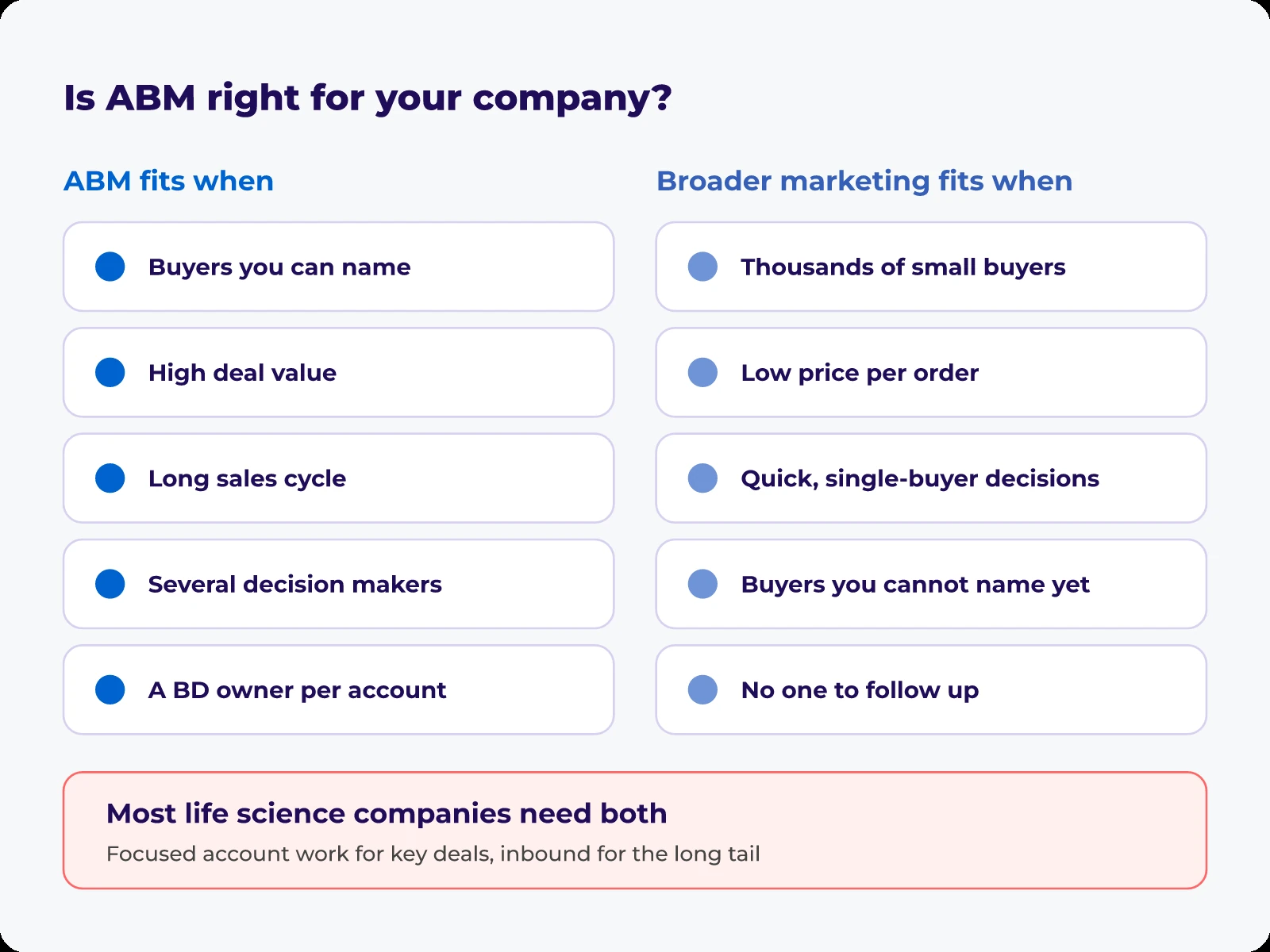
When should a biotech company use ABM?
I would consider ABM when most of these signals are true. One or two on their own is not enough.
| Signal | What it looks like in life science |
|---|---|
| A small, nameable market | A few hundred organisations at most could realistically buy or partner |
| High deal value | A platform sale, a multi-year service contract or a licensing deal |
| A long sales cycle | Months of evaluation, pilots, audits or tech transfer before a contract |
| Several decision makers | Scientists, QA, procurement and BD all weigh in |
| Someone to follow up | A sales or BD person owns each account and acts on what marketing sees |
| Room to expand | One site or department today, others in the same group later |
When ABM is the wrong choice
ABM is a poor fit when your buyers are many, small and hard to name. Pouring effort into a short list then means missing most of the people who would actually buy.
- Low-price, high-volume products: reagents, consumables or kits bought by thousands of researchers. Search and content usually work better, as covered in how academic labs actually buy.
- No agreed target list: if leadership cannot agree which accounts matter, ABM will expose that rather than fix it.
- Positioning still moving: tailored messages per account are wasted if the core story changes next quarter.
- Nobody to follow up: attention from a target account goes nowhere without a person who owns the relationship.
For many companies the answer is a mix: broad biotech inbound marketing for the long tail, and focused account work for the handful of deals that shape the year.
What should be in place before you start ABM?
Most ABM programmes that disappoint were missing the basics before the first campaign went out. Check that you have these ready.
- Agreed criteria for which accounts belong on the list, signed off by sales and leadership.
- A named owner in sales or BD for each target account.
- Clear positioning and messaging that holds up for scientists, QA and commercial buyers.
- Proof you can share: application notes, data, validation results or published work.
- Clean account and contact data in your CRM, with consent where it is needed.
- A time horizon that matches your sales cycle, so nobody judges it after one month.
Building the account list and the outreach around it is where most teams want a second pair of eyes. That is what our life science lead generation work is for.
ABM is a decision about focus, and biotech often rewards focus
Use ABM when a short list of accounts decides your year, and use broader marketing when it does not. Most biotech, CRO, CDMO and instrument companies have at least a few accounts that deserve the focused approach.
If you are still unsure whether more leads is the right goal at all, read why more traffic is usually the wrong goal in biotech lead generation.
Wondering whether ABM fits your company? Book a short call to talk through whether your market and sales cycle suit an account-based approach.
Frequently Asked Questions
ABM is not only for large companies, and it often suits small biotech teams with a short list of buyers. Biotech account based marketing on a handful of accounts can need less budget than broad campaigns. What it does need is time from someone in sales or BD, and a clear view of which accounts matter.
Key account management is a sales discipline for looking after existing large customers, while ABM is the marketing side of the same idea. ABM can also target prospects you have never sold to. The two work best together, with marketing and the account manager agreeing on the same accounts and messages.
ABM results follow your sales cycle, so judge it in quarters rather than weeks. Early signs are engagement from more people at a target account and first meetings that start further along. Revenue arrives when the deals close, which in life science can take many months.
Conferences and partnering events suit ABM well, because many target accounts gather in one place. Knowing in advance which accounts you want to meet, and who from each buying group will attend, turns a busy event into a set of planned conversations.